So I was feeling a little morbid today after going over the website I (and my groupmates) completed for class...
(Out of curiosity... can we ever see what everyone ELSE did? I think ours ROCKS!)
That said, though... a method and ritual surrounding burial kept cropping up during our research that didn't have so much to do with preventing the return of the dead... but rather to confound and generally make the inevitable return of the dead (typically if not in most cases a spirit or revenant or ghost).
Bear with me... this takes a bit a meandering twist.
Back in the 'olden days', a common punishment for traitors, murderers, highwaymen, and pirates - thanks to the Murder Act of 1752 in Britain was not ONLY execution, but 'hanging in chains'... more commonly known as the gallows.
 This fantastic 'preventative' was reserved for the truly dastardly and unrepentant and who were guilty of the most heinous crimes... and once they were executed, their bodies were strung up in metal cages on a major road or thoroughfare - typically a crossroads - so as to be able to show the populace the end-result of a life of crime.
Now... a crossroads was ALSO the typical burial place of murderers, as such outcasts were not likely to enter the gates of heaven and were thus buried in a place where their spirits would be forced to wander indecisively for eternity.
http://www.ushistory.org/oddities/gibbet.htm
To bury a criminal at a crossroads did a number of things: first, it might have safeguarded the populace, as the shape of the traditional crossroads (a literal cross) created the impression of consecrated ground, as suicides were denied a normal Christian burial; this however seems to not be consistent with the burial of murderers at a crossroads... as anyone evil that was buried and without a proper Christian burial tended to unhallow the ground around them. The concept was... if the ghost thought it was hallowed ground (being a cross and all) then they would be less inclined to be angry at their unChristian burial... it worked in theory...A second idea was to protect the populace from the wrath of the maligned spirits for not burying them in the traditional Christian method... and it was believed that the crossroads would confuse the spirits as to which direction those who wronged them lay. Further to the point, the crossroads were believed also to be a waystation for the spirits of the dead... with four different directions in which to travel, it was surmised that the maligned spirits of the dead would disperse along the roads leading from the crossroads and not be content to malinger in one spot... for TOO long, at any rate...
You see... crossroads - as a general rule - ended up getting a bad rap... and stories abound of ghostly legends, demons, the Devil, witches, fairies, and other paranormal phenomena all participating in their respective 'nefarious deeds' at a crossroads. So one surmises that the spirits of the departed didn't 'disperse' quite as readily as some people might have otherwise hoped.
Just to make sure I got it all straight... a criminal gets displayed in a gibbet after being executed... and then is (presumably) buried (in an UnChristian manner) at the same crossroads where he was displayed (records are somewhat vague on these details)... small wonder then that urban legends and myths about of restless spirits at a crossroads... I'd be a bit 'put out' as well, if MY body had been put on display after my execution, then buried without a proper Christian burial at a crossroads so I can't figure out which way to go... yet since the body was not buried properly, heaven isn't an option ANYway, so the spirit might as well stick around on earth... and since it can't figure out which road to travel on for all eternity (and let's face it, who wants to do all that walking?) the spirit might as well stay put.
It's rather like a self-fulfilling prophesy, really...
As an aside (or perhaps to bring the entire post full-circle), the world's only known complete gibbet was intended to have housed the decomposing remains of convicted pirate Thomas Wilkinson in 1781 once he had been hanged. Through a bizarre twist of fate, the gibbet was never to actually be used; Wilkinson actually escaped his fate due to the sympathies of a number of wealthy and influential townspersons, and the gibbet itself - after being moved to storage and then hung in Moyamensing Prison in Philadelphia as a warning to the prisoners - now resides at the Atwater Kent Museum in Philadelphia, Pennsylvania (and is shown in the picture above).
One can only surmise how angry a spirit might have become having spent time in THAT iron monstrosity...
 https://blogger.googleusercontent.com/img/b/R29vZ2xl/AVvXsEj1ti_dhLisqbbZXb2sDkcyOnJzrEYRexK6bN7ZCgs7_mcoIjLODAfl2lh5jG7yPeTSVWC8Y76-dyPKwbtrRFdZjI_O4pX8oVGYPwv_VRZJIQh8AeQn_rO8NuPp5r8dMaFbnUxlRN0c8vA/s320/charon.jpgIn doing research for a larger project, I stumbled (as I often do... 'stumble', that is) across some references to the practice of burying the dead with a coin in the mouth of the deceased.
Ancient texts of Greek and Roman literature and manuscripts from as far back as (around) 500 BCE up to approximately 200 AD make reference to the placement of a coin in the mouth of the dead so as to provide them with a fare for the mythological Ferryman of the River Styx, Charon.
I rather like the thought of a guided boat ride to the Underworld. It's seems to romanticize the concept of 'crossing over'.
Susan T. Stevens took things a little further. (You'll need a JSTOR account or access through a university to read the full article, my reference is on page 224 where Ms. Stevens references an earlier researcher's - D. M. Robinson's - findings concerning multiple and/or silver coins found during burial excavations).
During her investigations of various archaeological burial sites across Europe, Ms. Stevens noted a trend of both Greek and Roman occupied lands to follow in the 'tradition' of burying the deceased with a coin on the head or in the mouth, sometimes with extra coins which some researchers and anthropologists surmise might have been a gratuity or 'tip' to Charon to ensure a safe passage to the other side... "There's one for you for the fare... and four more in it for you if you kick him over the side of the boat when you're half-way across!"
https://blogger.googleusercontent.com/img/b/R29vZ2xl/AVvXsEj9zwqj5g_3zDqOblLtume4pWRJLEUAyMZSmWqYp-APKsLVDQJA4BnfcyiBYsGrE9Nv35-UP4bFcbKJUG4JDV7i9DVYEfAh92zW4guklxeA0h1JdbrmSGhxVN7_jSMaBr2EqGefvGzaK84/s320/Coins+-+merged.jpgThis author has a different view... what if, Dear Reader, the extra coins were intended for an altogether different reason?
Fairly recent speculation from Christian researchers has discovered new information about the 'Shroud of Turin', the discovered burial cloth that some are determinedly convinced was placed over the body of Jesus Christ. It turns out... through polarized image study of the Shroud, Chicago theology professor Francis Filas claimed the Shroud of Turin had evidence of having had coins placed over the area under which Jesus' eyes would have been.
Video of this can be found here:
http://www.youtube.com/watch?v=Wseb_dMGOnY
Waitasecond... TWO coins? Could it have been a gratuity, to ensure a safe trip?
... or perhaps... one coin for the trip THERE... and the second coin for a RETURN TRIP from the Land of the Dead?
... Courtesy of Charon, the mythological Ferryman of Greek legends?
... Did I just BLOW YOUR MIND? http://images2.wikia.nocookie.net/__cb20070228124616/dcanimated/images/1/15/Charon.jpg
"What do you MEAN you 'want to go back'? "
Digging around on the internet (har har) for stuff to blog about, I came across an article from 1999 discussing the discovered mummified remains of three children.
"So what?" you may say, "You are dealing with an entire class devoted to burial rites and rituals... what's the big deal about three 500-year old kids?"
First... the fact that they are suspected to be sacrifices... and of the Incan variety... and anyone that knows their history will know that there's not a lot LEFT of the Incan Empire, what with the Spaniards curb-stomping them in 1532-1535 and all... https://blogger.googleusercontent.com/img/b/R29vZ2xl/AVvXsEjJVt5VJUgvOhM1TfzlxLzENQ-C5Q2_9UUPSJFhnwT948l8X0pp2-_Jl14eoXDoqS3thNMS5sLPgANRH3HgXn7qU-IU_zQDO8MoDcVVKMXiuWr93prUsJsYxwNa08IU0ZXXlg_DhHz9e8c/s320/incan.jpg
  https://blogger.googleusercontent.com/img/b/R29vZ2xl/AVvXsEgejHcGzukykKhs7-cZBcFL8ZhNX7Q7-N4697TkCgygJWpElzitzAiZ1hZyibVjXu1B30KVrZHFJjUSYLAGDONaSOoTabwZfIrCAPd1VQlVNVHNNCqs71G9mloxM_gh78Y1hBejqZy3Zzc/s320/_312846_inca150.jpgSecond, the find was rich with grave goods (example above right)... 37 different gold, silver and shell statues, half of them clothed, as well as bundles of ornate textiles, moccasins and pottery, some still containing food.
That's a lot of (frozen) stuff.
Did I say frozen?
Oh yes, I certainly did; most critical to this investigation and discovery is the fact that the children were 'mummified' naturally... and the inclement weather conditions (110mph winds and freezing temperatures) made it so the bodies literally froze BEFORE they became dehydrated... such that all the organs of the children are still intact... to the point where blood was found still in their hearts. The little bodies are SO well preserved (right down to the hair on their arms) that some experts are baffled by their condition, claiming that their appearance is more that of a child that died a matter of weeks, or even days previous.
A further remarkable point is the fact that the researchers endured these same conditions severely in order to retrieve the three mummified children...
... because they were buried 22,000 feet (6,700 metres) above sea level on the summit of Mount Llullaillaco in Argentina.
Twenty two THOUSAND feet.
MY question is... considering the team of researchers had the latest advances in survival gear and were pushed to the limits of their endurance for twelve days until their find... HOW did the native Incans of 500 years past not only manage to GET the children (the cause of death had yet to be determined at the writing of the article, but sacrifice is suspected) up to the summit of Mount Llullaillaco - apparently a really tall volcano... but further to that point, how did they manage to STAY up there long enough to bury the children 1.5 meters in the earth?
http://news.bbc.co.uk/2/hi/science/nature/312846.stm
http://www.trussel.com/prehist/news116.htm
Victoria - being a city of a rich and uniquely vibrant history - predictably has a few unique stories to tell regarding her 'dearly departed'. There is no better place that one could go than to Ross Bay Cemetery to discover just how varied this history can be.Our intrepid crew of adventurers ventured out to the Ross Bay Cemetery one dark and foreboding evening after discussion of the Pooley Angel. Discovering few other angels, but a plethora of unique markers, the team set out to catalogue some of the the more-unique monuments of the gravesite. With a data set of eleven unique grave markers, we proceeded to analyze the markers (and their graves) in an attempt to answer our inquiry of whether or not economic factors were involved in the separation (and establishment) of these unique markers, whether there was additional factors involved in the placement of the unique markers and any other details that could be ascertained - such as whether the markers were for individuals or for groups.
Theoretically speaking, it stands to reason that the larger a grave monument is, the more material wealth the family of the interred placed upon the erection of said monument. Uniqueness of the marker might play a role in economic contribution as well. Did this hold true?
It was ascertained that there was a larger number of generally larger and more-elaborate unique grave markers within the 'older' portion of the cemetery along the north-east section; the graves to the south tended to be smaller in marker size (and thus apparent opulence). According to the history surrounding the Ross Bay Cemetery, the middle 1/3 was opened for burials in 1873, with the western third purchased and utilized as of 1900 and the eastern third in 1906. Of the data set, graves occur in all three 'third-area' and there seems to be no clear delineation as to economic status, other than the overall assumption that in order to be buried in a cemetery with such 'prime real estate' as Ross Bay Cemetery, one would have to have had family buried there already in a family plot (as is the case with the obvious markings on the Bossi, Pooley, Behnsen, Erickson, and Deans monuments) or some form of economic influence (possibly the case with the Pettapiece sundial).
http://www.oldcem.bc.ca/cem_rb_his.htm
Doing a catalogue search of the names on the markers did reveal a small mystery: "Amy Elizabeth Schultz" - the name on the 'Anchor' marker (#7) does not appear in the City of Victoria's burial records for Ross bay Cemetery. As a matter of fact, none of the Schultz's interred in Ross Bay share her date of death. Further adding to the mystery, she was buried in the 'General burial' section (not-necessarily religious) and in a specific section (K) that was used primarily for the burials of Chinese and Japanese immigrants as well as First Nations people until the opening of an additional section (N) for that purpose in 1906.
Whoever "Amy Elizabeth Schultz" was, she was significant enough to warrant having a great anchor placed on top of her gravesite...
http://web.victoria.ca/archives/rosssearch.asp
The cemetery was subdivided in 1879 due to some public concerns that not enough of the acreage was devoted to 'general burial', causing a bylaw to be passed and the Church of England (Anglican), the Roman Catholic Church and the Presbyterian Church (after paying $300 per acre) to be allotted their specific areas (Sections ABST, CDUV and H, respectively) for their burials. Of the graves on the data set, religion does not appear to play a key factor in specific site location, and one can only surmise the religion of the interred (or more likely correctly, the family of the interred) based upon their marker site.
Inspection of grave inscriptions for patterns to family burial proved to be a little more revealing; with the larger monuments of the north-east collection having plaques detailing entire families being buried together. Conversely, the newer the grave monuments (and subsequently the graves themselves) the more likely we were to find a smaller group (such as a couple) or an individual burial, which reflects different cultural practices concerning death within the family or society. Lewis Binford assessed age ranking as a determinant of mortuary significance, noting that:
"... in egalitarian societies, very young individuals should have very low rank and, hence, share duty-status relations with a very limited number of people" (Binford, 1971).
In this case, Binford's theory does not hold true, as two of the more noteworthy markers - the baby chair of David Burnside Campbell and the anchor of Ann Elizabeth Schultz (assuming Ms. Schultz's inscription of 'our baby' to be one of chronological age significance and not just an affectation) are both noteworthy markers in their size and uniqueness.
Regardless of the mystery surrounding the uniqueness of this data set, I feel it can be safely assumed that uniqueness of character (or possibly social status within the community) and not necessarily specific economic status was the main reasoning for the individuality of the grave markers, and that as time wore on, individual grave markers became the norm as opposed to internment within a family plot with one's relations.
References
1. Adams, J. 1983. Historic guide to Ross Bay Cemetery. Victoria, BC: Sono Nis Press.
2. Binford, L. 1971. Mortuary practices: Their study and their potential. Memoirs of the Society for American Archaeology, (25), 6-29.
http://web.victoria.ca
http://www.oldcem.bc.ca
Now THIS is a neat idea:
http://www.treehugger.com/files/2009/10/dead-people-are-cool-crematorium-heat-powers-air-conditioning.php
Apparently the Taipei Second Funeral Parlor in Taiwan plan is now harnessing waste heat from their crematorium furnaces and running it through a heat exchanger to generate electricity to run the air-conditioning system.
The best part? It caught on. A crematorium in East Sussex started doing the same thing in December 2009:
http://flickeringpictures.com/2009/12/11/uk-crematorium-plans-to-convert-corpses-into-electricity/
Okay, granted, the specific heat of the cremations themselves isn't the ONLY heat energy being converted into electricity (there's apparently a LOT of waste heat generated by the furnace required to render Uncle Fester into a pile of ashes), but it's still an efficient concept - moreso than not doing it at all, at any rate... so why stop there? I mean... humans are living bio-electrical batteries that general quite a lot of extraneous heat and energy... but then my next question is... how far are we away from THIS?

http://yoavdembak.files.wordpress.com/2009/09/free-yourself-from-the-matrix.jpg
'Status' - if one was to crack open an Anthropology textbook or look it up online, is defined as:
"the position one has in a social network. The name of a position given to a node."
http://oregonstate.edu/instruct/anth370/gloss.html
In terms of death and burial, I think that status might be a bit more (and a bit less) nebulous.
In most cases, we - as modern Homo sapiens sapiens - come across a dead person in a grave and arbitrarily decide that they were either rich or poor and attribute similar 'rankings' and 'status' upon the remains by observation of the grave itself and the surrounding terrain, the size/shape of the grave and the non-human contents within. Are we using scientific evidence to support our claims, correct, or (at best) are we using empirical data to make 'educated guesses' based upon the fact that patterns of similar activity exist elsewhere in the world... and coincidences aren't all that common?
For the most part, I think archaeologists use the blanket-term 'status' to mean a rank within the community in which the deceased lived... and rely upon the grave markers, positions, trinkets and adornments interred with the remains and comparisons to other (possibly more mundane or 'average') graves as a litmus test against this one person's ranking within their society. larger grave, larger burial mound, more grave goods, separate location or location of significance, all of these have been used to measure the status of one individual versus another in the same location of the burial, and elsewhere and even across different cultures.
Is it accurate? Somewhat. In the absence of any better way to do things, it's the best way we have to make these assertions. It's much like painting a picture in the dark, not knowing either the colour of the paints we must use nor the size of the canvas.
The term status, I think, is therefore a little general in scope... Status can mean a rank within a community, a rank within a specific subset of the community (like age sets) or a religious, spiritual or socio-political ranking to separate the deceased from the 'common citizen' of his or her society. Status can mean a lot of things - depending upon the society, and a person can technically have been of more than one statuses, or have held different statuses - much like I an an 'uncle', a 'student', a 'medical professional', a 'cat-owner', a 'husband' and a 'son'.
The largest issue, I think that would interfere with the specific identification of a deceased's status is the open-ended definition of the term 'status' itself, and also our assumptions of what, exactly the deceased's culture was like.
According to Anthropological canon, 'husband' and 'wife' are deemed positions of status, in that, they are a defined position within a social network'. The problem comes when we find a pair of bodies in a grave... assuming one male and one female, most would immediately assume that the pair was a married couple, and append the statuses of 'husband and wife' onto them. Mostly for convenience, as it sews up everything into a nice little package... but what if the society was of a kind that encouraged the possession of slaves - perhaps it was a mark of status for a male tribe leader (or any male) to be buried with his favorite slave girl. Without context, we really have no true way of knowing for absolute certain.
Without actually having 'been' there, all we can do is make somewhat-educated guesses and assumptions.
All that being said and done, the picture looks alright so far...
From the 'News of the Weird' Department:
I give you two modern practices and one semi-modern one that has been outlawed.
First, the Space Burial:
http://en.wikipedia.org/wiki/Space_burial
http://www.memorialspaceflights.com/images/UP_Aerospace_rocket-tractory.gifWhere apparently you are cremated, part of your remains are stuffed into a canister the size of a tube of lipstick and then fired into space to orbit around the earth. One immediate question comes to my mind... what happens when the orbit of the capsule you are in (and whoever else's remains are up there with yours) degrades to the point where it falls out of orbit and back to the earth?
You're going to freak the heck out of some UFO conspirist in Arizona, is what's going to happen...
Moving on to something with a little less 'pomp', but just as much circumstance... the 'Fireworks' ash scattering method.
I kind of like this idea... pack your loved one's ashes into a firework or set of them and light a match! Hilarity ensues!

http://farm2.static.flickr.com/1438/723251706_7e02c1f448.jpgIn all seriousness, though... it's rather interesting... either you can arrange for a service such as http://www.heavenlystarsfireworks.com/ to do your fireworks show FOR you, OR you can send an amount of your loved one's remains to the company and they'll pack them int fireworks and send you the box to set up and fire off yourself!
Subject, of course, to local bylaws about shooting fireworks into the night sky, you have the perfect reason to 'celebrate' the passing of your loved on... you MIGHT, however, want to warn people the dust those particles of Uncle Jerry out of their hair...
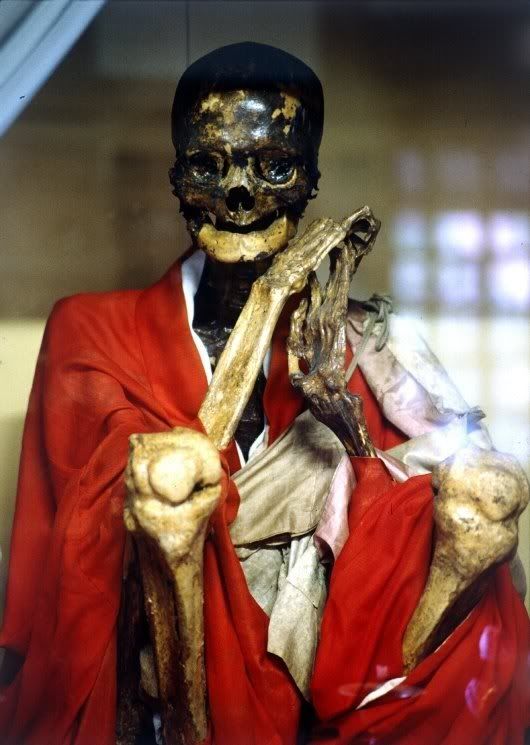
And finally, I must ask what level of devotion to ANY religion (in this case Buddhism) would cause someone to want to do THIS to themselves? http://i158.photobucket.com/albums/t119/ilkeryoldas/mumonk.jpg
Sokushinbutsu. "Living Buddhas".
http://en.wikipedia.org/wiki/Sokushinbutsu
It took around three thousand days to accomplish this (a practice called "nyūjō")... if it worked at all... one thousand days of a special diet and rigorous exercise to divest the body of body fat, followed by one thousand days of eating nothing but bark and roots and drinking a tea made from poisonous tree sap (inducing vomiting and body fluids) then sealing oneself in a specially-made tomb in the lotus position with nothing but a breathing tube.
Once per day, the monk rang the bell inside to let those on the outside know he was still alive. When the bell stopped ringing, they sealed the tomb completely for ANOTHER one thousand days and waited.
To those who failed to become mummies (and were, instead, simply rotted corpses) the locals still revered them for their level of dedication. On rare occasion, however, mummification was successful and the remains are declared to be a Buddha and put on display!
Japan banned the unburying of them in 1879 and assisted suicide has since been declared illegal in Japan... and no Buddhist sects today advocate or practice this.
 This fantastic 'preventative' was reserved for the truly dastardly and unrepentant and who were guilty of the most heinous crimes... and once they were executed, their bodies were strung up in metal cages on a major road or thoroughfare - typically a crossroads - so as to be able to show the populace the end-result of a life of crime.